
Important note: this is an example of a manual stock pick our team made before we launched the current AI-powered version of our product. The text below offers insight into our historical research thinking and will stay published.
On July 1st, Lemma Capital purchased Duolingo, Inc. stock for the first time for its “Future AI Leaders” portfolio at an average price of $122.01 per share. The following publication explains our decision and provides a narrative for tracking Duolingo’s business development. It also highlights our quantitative framework for valuing growth companies.
Summary
Duolingo’s recent growth slowdown and sharp valuation reset create an attractive entry point: the stock now trades at roughly 5x P/S, versus a 7.4x one-year historical median as a near-term anchor.
The next growth leg could come from Duolingo’s transformation into an AI-powered virtual tutor, combining personalized speaking and tutoring features with its existing advantages in gamification, habit formation, brand, and a massive installed user base.
Expansion beyond languages into Math, Music, and Chess provides additional growth vectors toward management’s goal of 100 million DAUs by 2028, with Chess already exceeding 7 million DAUs.
The financial foundation remains unusually solid: Duolingo has ~$1.1 billion of cash, no financial debt, strong free cash flow, and can fund aggressive AI investment while using buybacks to offset stock-based compensation dilution.
Our thesis is that Duolingo is increasingly an overlooked consumer AI company: if AI-driven product improvements restore growth, revenue expansion alone can generate attractive returns, with additional upside from a potential recovery in its valuation multiple.
Background
Duolingo was founded in August 2011 by Luis von Ahn and Severin Hacker, who met at Carnegie Mellon and were both software engineers by training. Von Ahn became the CEO and had already built and exited reCAPTCHA in a multi-million-dollar acquisition by Google in 2009, while Hacker, his graduate student at Carnegie Mellon, became Duolingo’s technical co-founder. The duo (duo!) launched the app to the public in June 2012, starting as a free language-learning product built around short, gamified lessons. The company went on to raise $183 million from top VC investors including Union Square Ventures, Kleiner Perkins, New Enterprise Associates, and Tim Ferriss - a capital formation streak that culminated with a NASDAQ IPO in 2021, where DUOL was valued at $3.7B with a $102 price per share.
To this day, languages remain the core of the platform: the app teaches all major global ones such as English, Spanish, French, German, and Chinese, but also a long tail of something less common, including Irish and Hawaiian (with more people learning some of them than there are native speakers worldwide). The functionality even extends to artificial or fictional languages such as Esperanto and Klingon (from the Star Trek movie), with the total number of languages taught exceeding 40, while recently math (2022), music (2023), and chess (2025) were added as separate learning categories within the same app.
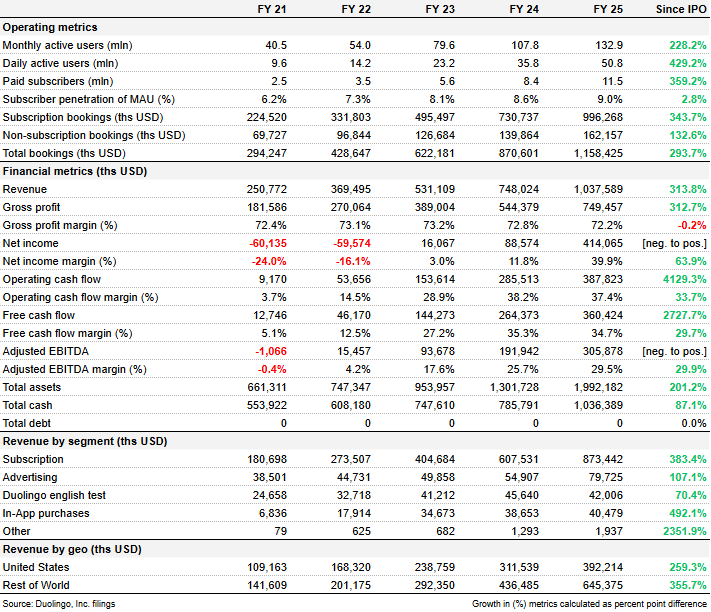
Since the IPO, the business expanded across all key operating metrics - such as free users, paid subscribers, bookings, revenue, and profitability - making Duolingo, by many counts, the single largest educational mobile app in the world. What’s even more impressive, all this was achieved without borrowing and while maintaining a strong cash flow profile:
That stellar track record and the company’s declared shift to “AI-first” propelled the stock to its all-time high of $530 in mid-2025. What followed, however, was a series of reports showing a slowdown in user growth, resulting in a comparatively faint second quarter of 2021, where year-on-year MAU growth rate scored single digits for the first time since the IPO:
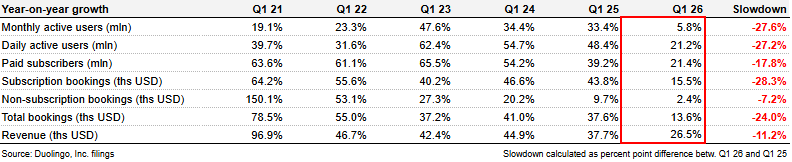
This was another negative trigger amid the prevailing “SaaS-pocalypse” narrative that old-fashioned software is about to get eaten by AI. The stock took a hit, dropping to around $132 per share, where it trades today, just ~30% above the IPO level*. The drop, however, opens up a major buying opportunity.
A little technical introduction to valuing growth companies
When buying stocks, most investors aim to make money by reselling them at a higher price. That chain of transactions is completed when someone buys a stock to hold it forever. For that “ultimate buyer”, the only way to recoup the money (and earn a profit) is if the stock starts paying dividends or the company buys it back. To make it work, the company has to generate free cash flow, which typically** requires revenue exceeding all cash costs, with the difference being the free cash flow (FCF***) margin. That usually happens in later stages of the company’s life cycle, which is often referred to as “steady state”.
So the rational approach to valuing companies is to view the share price as a product of expected (or forward) revenue and FCF margin, divided by the growth-adjusted discount rate we believe the ultimate buyer will accept. This concept is closely linked to the Gordon model:

As we do our exercise, however, the company might be far from steady state. To make up for that, we discount those future values back to the present. First, we rewrite the right part of the equation using forward Revenue and a Price-to-Sales ratio (P/S), the latter being a well-known indicator of how pricey a stock is:

We then apply discounting and rewrite the equation again, linking forward and current, or trailing 12-month, revenue through a parameter we call Discounted Growth Factor (DGF):

What sits inside DGF are: a) expected revenue growth rate on the path to steady-state, b) the rate we use to discount the future values to the present moment, and c) the number of years we believe the rapid growth phase shall last till business slows down and begins returning money through dividends and buybacks. Take a moment to reflect on the valuation math:

We can simplify this further by combining DGF and P/S together into current P/S. This little trick makes the writing more compact and easier to apply in practice, as it allows working with observable historical data to track valuation dynamics over time:

Over the past 3 years, buyers and sellers have been, on average, accepting a P/S ratio of 14x, but the recent price drop has brought that number down to nearly 5x:
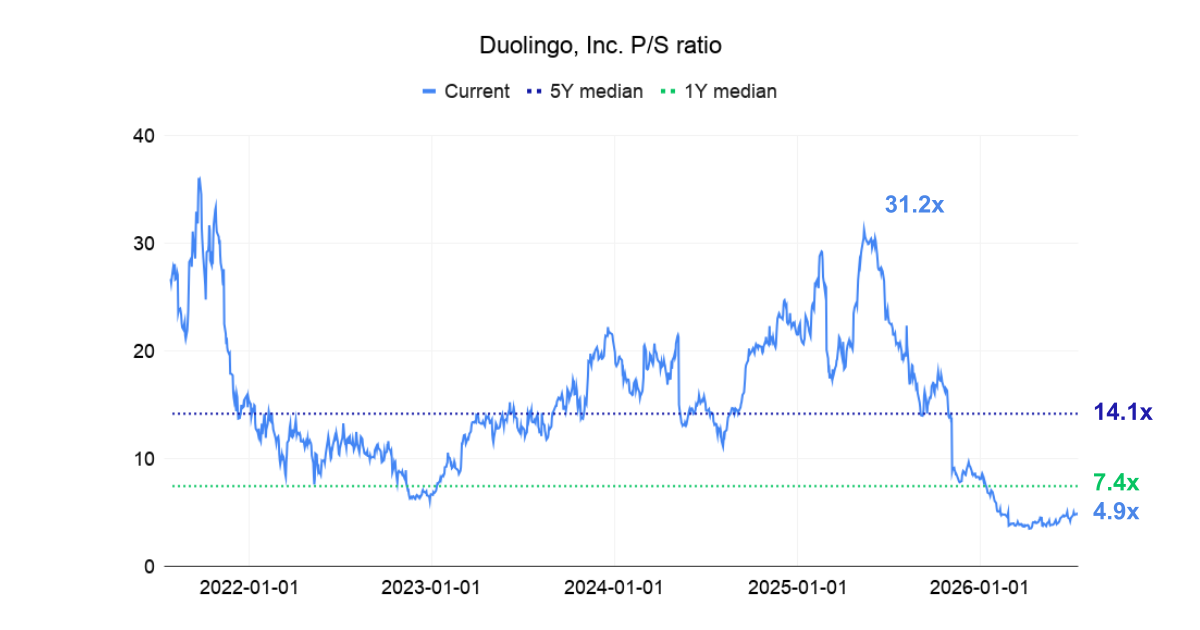
The collapse in P/S did, of course, happen because of the slowdown in user growth as investors took a more humble view of Duolingo’s prospects, thereby recalculating the DGF and de-rating the stock. But apparently, the company is about to make a comeback as a growth play, potentially launching the P/S multiple back in the 7.4-14.1x range.
Why we're buying Duolingo
While there’s a whole bucket of opinions about how Duolingo’s going to re-ignite the growth (a good summary of the discussion can be found here), its next expansion streak is likely coming from where growth happens these days in online education: AI-powered products. The best example of this new breed is Speak.com, an AI language tutor app that is believed to grow from $15 to $100 million in ARR in a single year in 2025, according to Latka.com. Though this data is largely self-reported and should be treated with diligence, if true, that would represent more than a 500% annual revenue increase. A valuable lesson for Duolingo, which remains much larger by total audience - for example, 500 million vs 10 million total Google Play downloads - and revenue.
The green owl, though, excels not only at teaching, but at learning too. In the famous internal email where von Ahn acknowledged the inevitability of AI adoption at Duolingo (creating backlash on social media), he stated that AI is opening up a possibility to “teach as well as the best human tutors”, meaning that personalized AI tutorship is within reach and that building around this vision must become the company’s top priority. The strategic leap, however, requires investing in new product features and pushing access down to lower subscription tiers to gain more customer feedback and usage data. That’s why the company gave conservative guidance for the 2026 financial year, which is simply coming true.
Executing on the transformation roadmap, the company moved its fresh AI features down to cheaper plans, making them available to a wider audience: for example, the “Video Call with Lily” was extended from only Max plans to include Super users, while both free and paid subscribers will receive more AI-powered speaking practice, aka “Speaking tokens”, “Flashcards”, and “Speaking Adventures”. Meanwhile, the main competitor is actively replicating Duolingo’s signature gamification and social features, trying to close the gap between more of a Swiss-army-knife-like translation tool and the habit-forming machine Duo already is. Seems like the two companies are going head-on with each other!
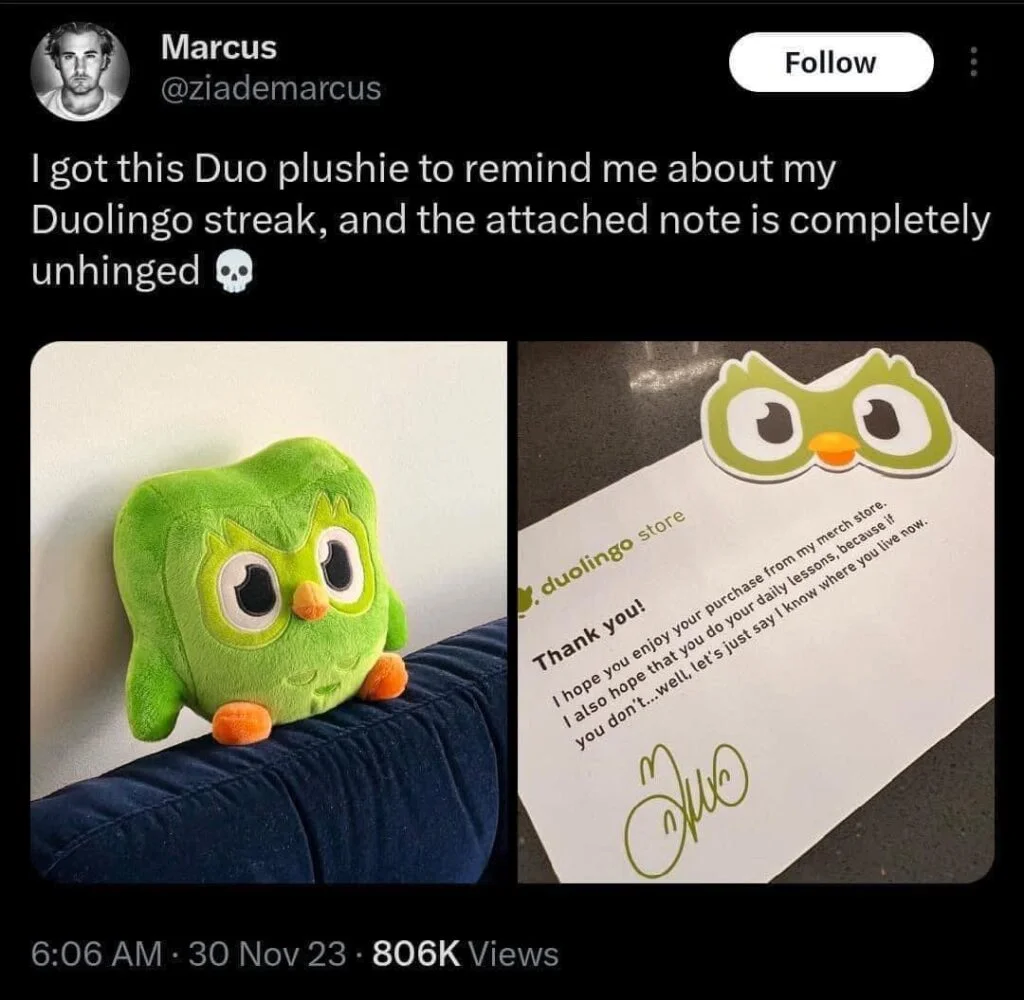
Who’s going to win? Duolingo’s brand is probably its strongest weapon. It rests on two things: marketing that people actually want to watch, and proof that the product works. The deliberately unhinged social media has turned Duo from a mascot into a well-known internet character: the app does not market itself like a traditional education business. It makes jokes, follows memes, and creates content that users share on their own. This gives Duolingo a steady stream of organic attention that competitors would struggle to copy without looking forced. The marketing is also backed by real learning outcomes. Studies cited by Duolingo found that users completing parts of its Spanish and French courses reached reading and listening levels comparable to several university semesters, while research on English learners showed progress across all language modalities - speaking, writing, reading, and listening. This combination blends into a unique advantage for Duo: it’s fun enough to capture attention, but useful enough to keep users coming back and actually improving their skills.
Another fear is that, with the advent of AI chatbots, Duolingo will start losing market share not exactly to specialized players, but to general-purpose tools like ChatGPT and Claude. There’s a thick line between the two categories, though. Chatbots are becoming unmatched for quick explanations and deep dives into topics of greater interest, but language learning is mostly about building a daily habit that gradually lifts one’s level. That takes a structured series of engaging lessons, and if the users were to create their own curriculum, they would have to decide what to study, which questions to ask, and how to keep their motivation high. Duolingo removes that burden: it gives the next lesson and tracks progress, while adjusting difficulty and gamifying the process to keep the habit alive. Duolingo can also add the best chatbot features inside its own product, as it is already doing with Video Call. So the more likely outcome is not that chatbots replace Duolingo, but that Duolingo puts the same technology inside a product with better teaching capability and rolls it out to an existing user base. While not a threat to habitual learners, the spread of chatbots is expected to drive away some casual learners anyway, however.
Another thing that will make Duo’s flywheel spin faster is its ongoing expansion into new subjects, like Math, Music, and Chess: management now describes those as Duolingo’s next growth engines and sees them as part of the path to 100 million DAUs in 2028. Chess is the clearest early success: it reached more than 7 million DAUs in under a year and is now Duolingo’s fastest-growing subject. The company plans to add features such as game review and opening practice, while putting more marketing behind the course. Math is a much larger long-term market with around 1 billion K-12 learners (per von Ahn), and Music is being redesigned to feel more like a game with Duo’s acquisition of NextBeat Gaming Studio. These new products can bring in new users while giving existing users more reasons to open the app, raising the value of a single subscription: all new subjects are available within existing plans.
As is often true, massive change requires extra resources, but Duo’s financial position has been exceptional: the company ended Q1 2026 with around $1.1 billion in cash and carries zero financial debt, giving it much room to invest through the uncertain period without relying on external capital. The ability to generate cash also scaled quite well alongside revenue, supported by annual subscriptions being paid in advance: in 2025, the FCF margin remained close to 35%. The trend strengthened further in Q1 2026, when the FCF margin reached 50.6% - more than double that of META, not to mention other players in online education. This means the underlying business model is highly sustainable.
Duolingo should also benefit from AI on the cost side, as course development has traditionally required large teams of curriculum designers, translators, and voice actors, making expansion into new languages and subjects slow and expensive. AI now allows the same-sized teams to produce far more content: Duolingo has increased its output from 7,200 course units for all of 2024 to 20,500 in Q1 2026 alone, without a proportional increase in headcount.
Generative AI products, however, can introduce meaningful inference costs. As Duolingo expands access to AI-powered features, management expects gross margin to decline from approximately 71% in Q1 2026 to roughly 69% for the rest of FY 2026. The near-term benefit is therefore higher product velocity rather than lower cost of revenue. Although the economics should improve if global model and inference costs continue to fall, this is our operating assumption - not something already reflected in Duo’s margins.
Another thing to keep in mind is that the company actively relies on stock-based compensation to retain top talent: even when applying AI to content production, someone has to put that AI to work. Hence, Duo’s long-term performance depends heavily on the creative power of its people, for many of whom an attractive equity compensation might be a deciding factor in joining. The relevant question is whether the dilution is matched by growth in intrinsic value of shares, and whether the company can manage the resulting increase in its share count. Good news: in February 2026, the Board authorized a $400 million share buyback program, and the company has already repurchased over 514,000 shares for nearly $50.6 million, offsetting more than 100% of its 2025 dilution.
Here’s a cherry on top: Duolingo remains controlled by its founders. Luis von Ahn and Severin Hacker remain the owners-operators, who together control 75.8% of the company’s voting power, despite owning a much smaller share of its economic interest. Public shareholders therefore have limited influence over the company, but the people making its main strategic and product decisions are the same people whose wealth and reputations remain tied to its long-term performance.
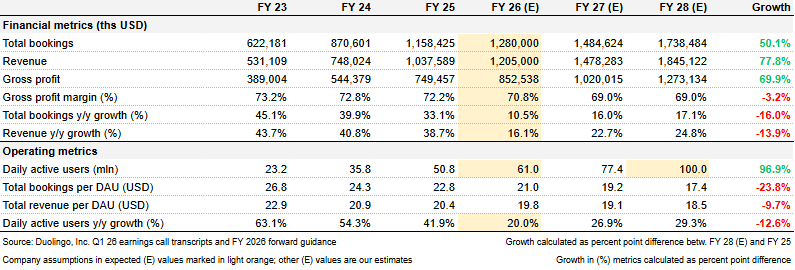
Let’s move on to valuation. Duolingo has historically been conservative when giving forward guidance, which often resulted in earnings “beats”, so we’re taking the 100 million DAU target by 2028 as a “good enough” anchor for our projections. The company sees 20% DAU growth by the end of FY 2026 and a decrease in gross margins to 69% by year-end 70.8% full-year average). There’s also a long-term downtrend in total bookings per DAU, mainly caused by making the free version more and more sufficient for mass learners. The company is fighting that trend by adding extra granularity between free and paid plans, though no additional guidance was provided on whether the trend will soon reverse or flatten, so we’ll take a conservative view:
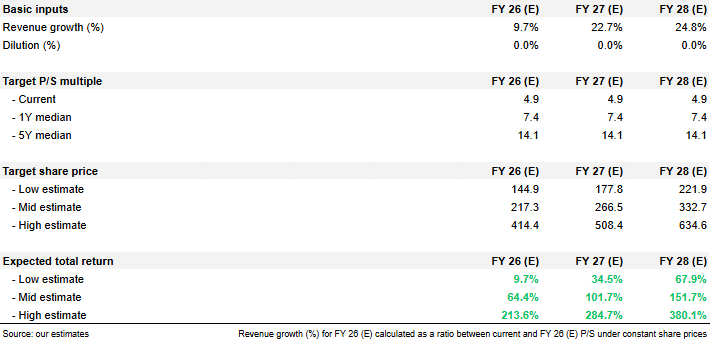
Taking the current P/S multiple of 4.9x and the revenue projections, here’s our view of Duolingo share price targets. Even if the multiple doesn’t jump back to the 1-5Y median range and continues to trade around the current level (under the “Low estimate” scenario), revenue growth will serve as our return driver:
At last, we should quote one of von Ahn’s recent shareholder letters because it provides a clear framework of what Duolingo already is, rather than what it aims to become: “Outside of the frontier model companies, we have created one of the most commercially successful consumer AI products.” To put things simply, it’s an AI company, which we believe is mostly overlooked by investors - a rare beast these days when AI stocks trade at multiples that spark bubble debates here and there.
All said, we think it’s rational to expect that on a 1-3 year time frame the price meets the target, producing a decent absolute return. We continue to watch Duo’s business development on the journey to becoming an all-in-one (or OWL-in-one, if you enjoy puns) AI tutor, and stand ready to update our opinion if any fundamentals change.
*At the time of writing.
**On rare occasions, free cash flow can be squeezed from selling a company’s net assets, making the so-called “net-net” investment opportunity, but that’s not our case.
***The simplification is intentional; being completely correct, it's FCFE, or free cash flow to equity.
Disclaimer
Lemma Capital LLC and/or its principals hold positions in Duolingo, Inc. (NASDAQ: DUOL).